
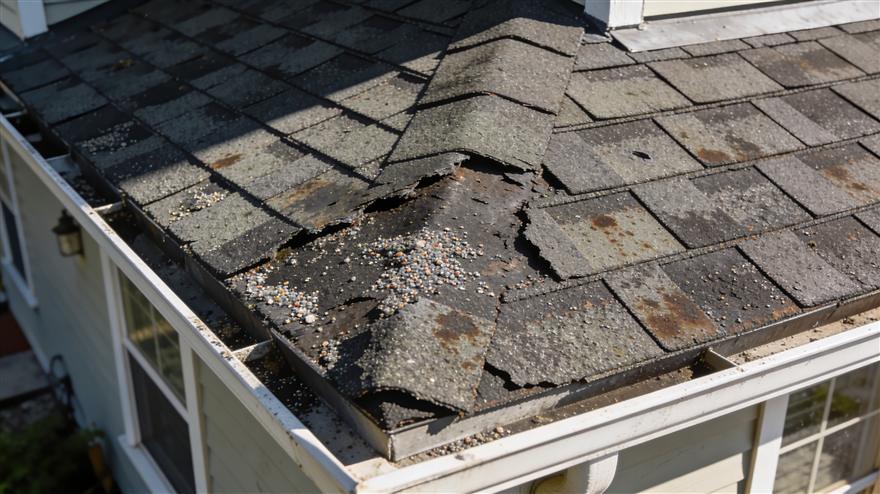
A homeowner notices a water stain on the ceiling at 9 p.m. on a Saturday. They search for a roofer, call the first number, and get voicemail. They do not leave a message. They call the second number. Whoever answers that call usually gets the inspection, and often the job.
That is the whole case for an answering service for roofers. The question is not whether to cover the phone when your crew is on a roof or your office is closed. It is which kind of coverage actually turns those calls into booked inspections. This guide compares the five real options (voicemail, a live remote receptionist, a traditional answering service, an AI receptionist, and a hybrid of AI and people), walks through one after-hours call minute by minute, and gives you a checklist to test any service before you sign.
Why Roofers Miss the Calls That Matter
Roofing has an awkward calling pattern. Homeowners notice problems when they are home: evenings, weekends, and right after a storm. Your office is staffed during business hours, and your reps and crews spend most of the day on roofs or in the truck. That mismatch produces four kinds of call that regularly go unanswered.
- Daytime calls during the work. The people who answer the phone are the same people doing the work.
- Evening and weekend leads. People who finally have time to deal with the roof, often calling several roofers in a row.
- Storm-night surges. After hail or high wind, calls arrive in waves that no single office line can handle, even during business hours.
- Emergencies. Active leaks and open roofs that cannot wait until Monday and need a person, not a message.
Each one needs a different response. A new lead needs to be qualified and booked. A storm caller needs a slot on the inspection list fast. An emergency needs a human on the line. Good coverage handles all four, and then leaves a clean record so the follow-up actually happens.
The Five Options, Compared
Most roofing companies end up choosing among these five. None is perfect, and the right answer for many companies is a combination.
| Voicemail | Live remote receptionist | Answering service | AI receptionist | Hybrid (AI + people) | |
|---|---|---|---|---|---|
| Hours | Always on, nobody answers | Usually business hours; after hours costs extra | Often 24/7 | 24/7, including weekends and holidays | 24/7, with people for set calls and hours |
| Storm-day volume | Fills up, callers move on | Limited by staff on shift | Can queue during spikes | Answers calls in parallel | AI absorbs the surge; people take escalations |
| Roofing questions | None | Depends on training | Usually generic scripts | Configured with your questions: address, damage, roof age, insurance, urgency | Same as AI, plus human judgment on unusual calls |
| Books appointments | No | Sometimes | Often message-taking only | Yes, against live calendar availability | Yes |
| CRM entry | Manual, if someone listens | Manual | Messages by email or text, re-typed later | Lead created automatically with a transcript | Automatic |
| Typical pricing model | Free | Monthly fee or hourly | Per minute or per call | Usually a subscription | Subscription plus staff time |
| Best for | Nothing you want to grow | Existing customers and sensitive conversations | A live voice when booking is not needed | New leads, after hours, overflow, storm surges | Most growing roofing companies |
Two notes on that table. First, "answered" is not the same as "booked." A message that says "call Mrs. Lopez back about a leak" still leaves the hardest part of the job, getting the inspection on the calendar, for Monday morning. Second, compare options on cost per booked inspection, not cost per minute. A cheap service that books nothing is the expensive one.
A Saturday 9 p.m. Leak Call, Minute by Minute
Here is what good after-hours coverage looks like in practice, using an AI receptionist with a human on-call rotation behind it. The same sequence is the standard to hold any service to.
- 9:02:00. The call rings through. The AI answers within a couple of rings with your company name, not a phone tree. If the number matches an existing customer, it greets them as one.
- 9:02:10. The caller says water is coming through a bedroom ceiling. The AI asks the first question that matters: is water coming in right now?
- 9:02:25. Yes. That matches your emergency rule, so the AI says it is treating this as an emergency and getting a person on the line. While the transfer starts, it confirms the address and a callback number, in case the call drops.
- 9:02:45. It gives simple safety steps: move belongings, put a bucket under the drip, stay away from wet ceilings and light fixtures.
- 9:03:00. The on-call rep joins with the caller's details already attached and arranges an emergency tarp.
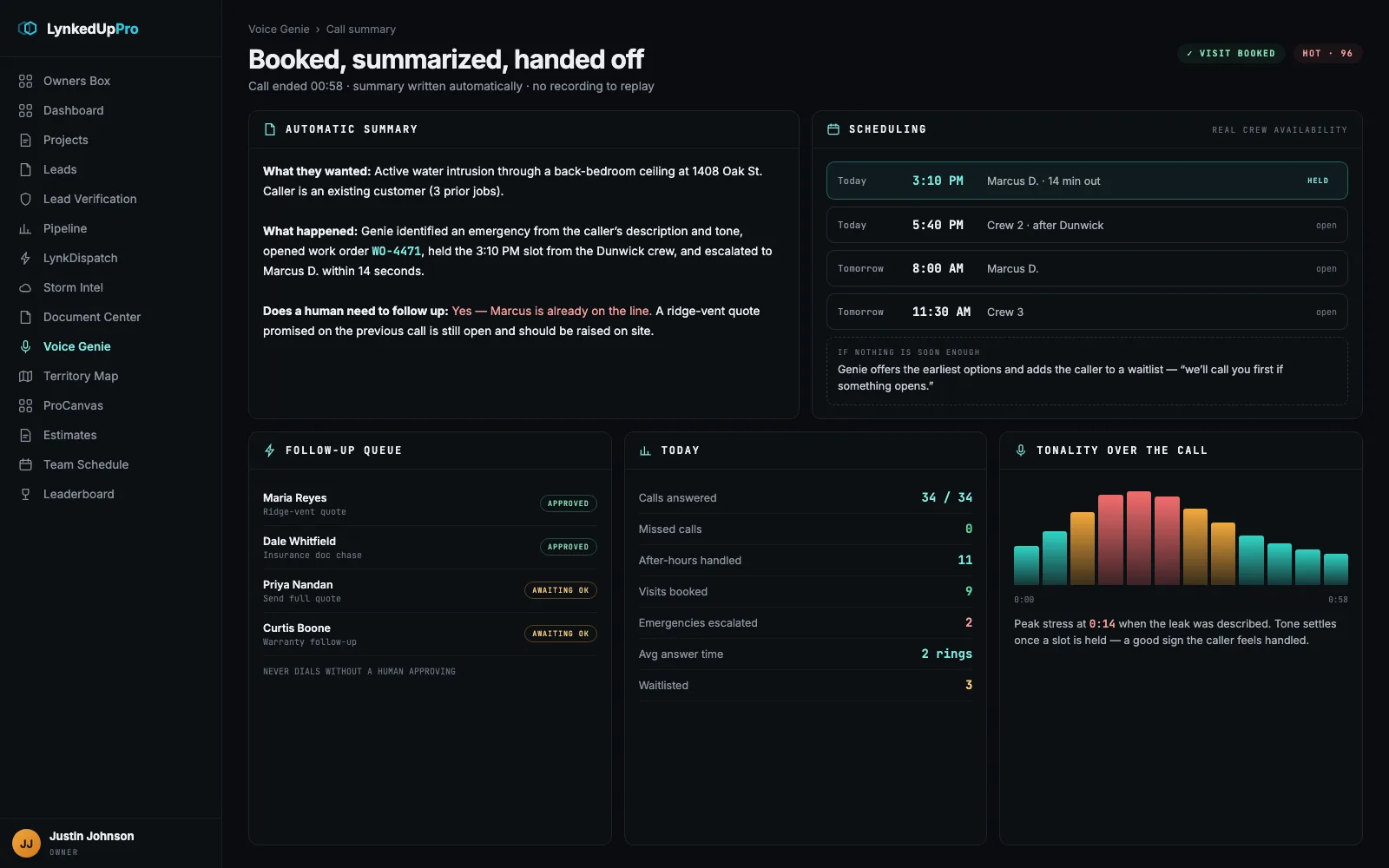
- 9:05. The call ends. The CRM already holds a lead with the address, the damage description, the urgency, the transcript, and an automatic summary that says a human has taken over.
- 9:06. The homeowner gets a text confirming who is coming and when.
- Monday, 7:30 a.m. The office opens to a ranked list of weekend calls, not a voicemail box. This caller is at the top, and the full inspection with insurance documentation is already on the rep's calendar for Monday afternoon.
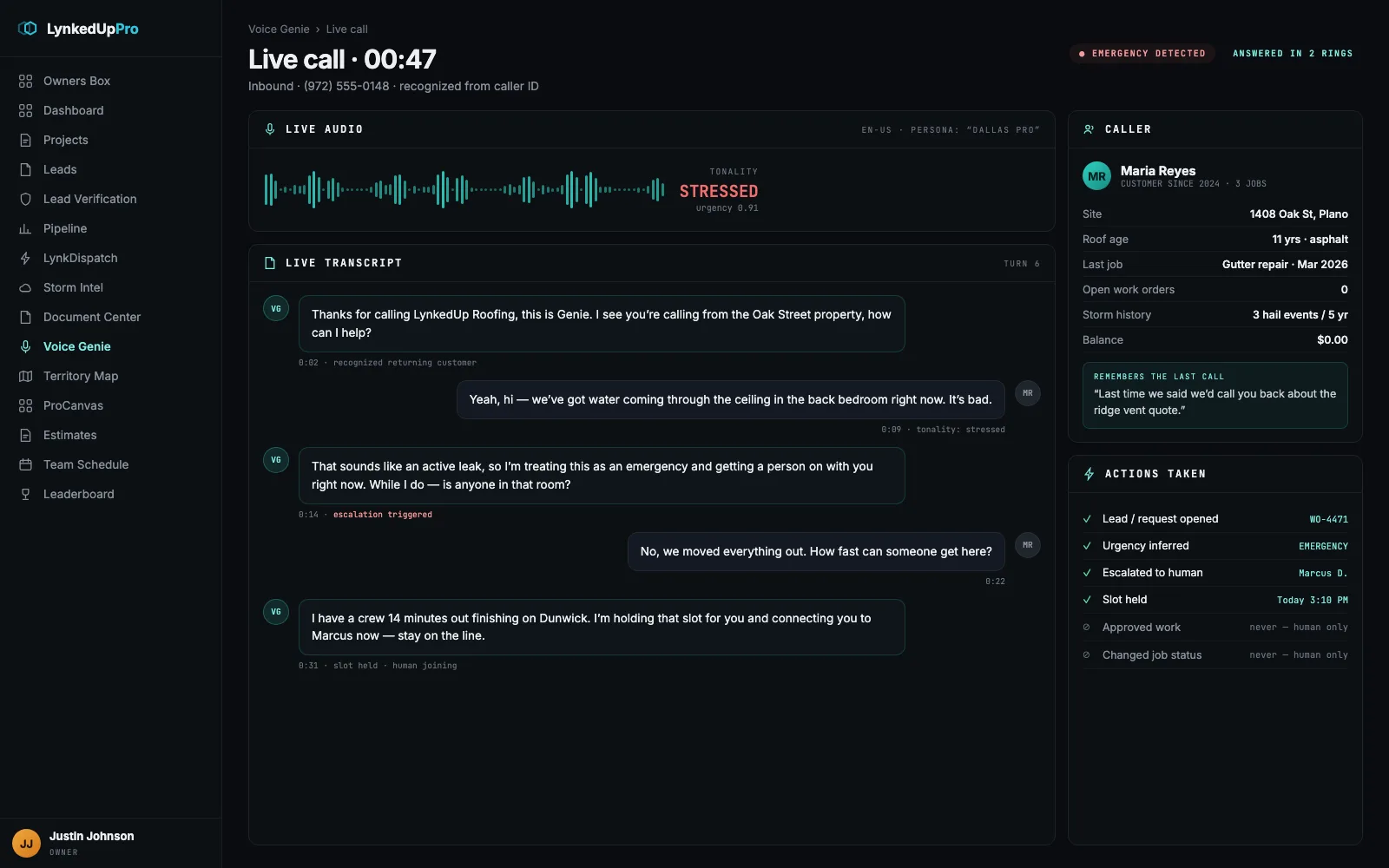
Notice what the AI did not do. It did not diagnose the roof, quote a price, or promise an insurance outcome. It qualified, protected the homeowner, handed off to a person, and wrote everything down. That division of labour is what makes AI coverage safe for roofing.
What a Roofing Call Has to Capture
A generic receptionist takes a name and number. A roofing call needs enough to decide whether this is a job and who should take it. Whoever answers your phone, person or AI, should capture:
- Property address, for territory routing, storm history, and measurements.
- Type of problem: leak, missing shingles, hail or wind damage, repair, or full replacement.
- Urgency: is water coming in right now?
- Roof age and material, if the caller knows.
- Insurance status: has a claim been filed, and with which carrier?
- Who needs to attend, so every decision maker is at the inspection.
- A specific inspection time, offered as two options rather than "when works for you?"
- How they heard about you, so you know which marketing produces inspections.
For exact wording, objection handling, and the emergency path, see our roofing phone script. It works as the brief for a human receptionist and as the configuration for an AI one.
How to Combine AI and People
The setup that works for most growing roofers is not AI instead of people. It is AI in front of people, with clear rules about who handles what.
| Call type | Who handles it | Why |
|---|---|---|
| New lead, business hours, office free | Office staff (AI as overflow) | A person builds trust when one is available |
| New lead, office busy or crew on a roof | AI receptionist | Answers, qualifies, and books instead of going to voicemail |
| Evenings, weekends, holidays | AI receptionist | Books inspections while you are off the clock |
| Storm-night surge | AI receptionist | Answers many calls at once; books by territory |
| Active leak or safety issue | AI captures details, then live transfer to on-call person | Emergencies need a human and a tarp |
| Existing customer with a job in progress | Routed to the person who owns the job | They should not be treated like a new lead |
| Pricing, insurance disputes, complaints | A person | Judgment calls stay with your team |
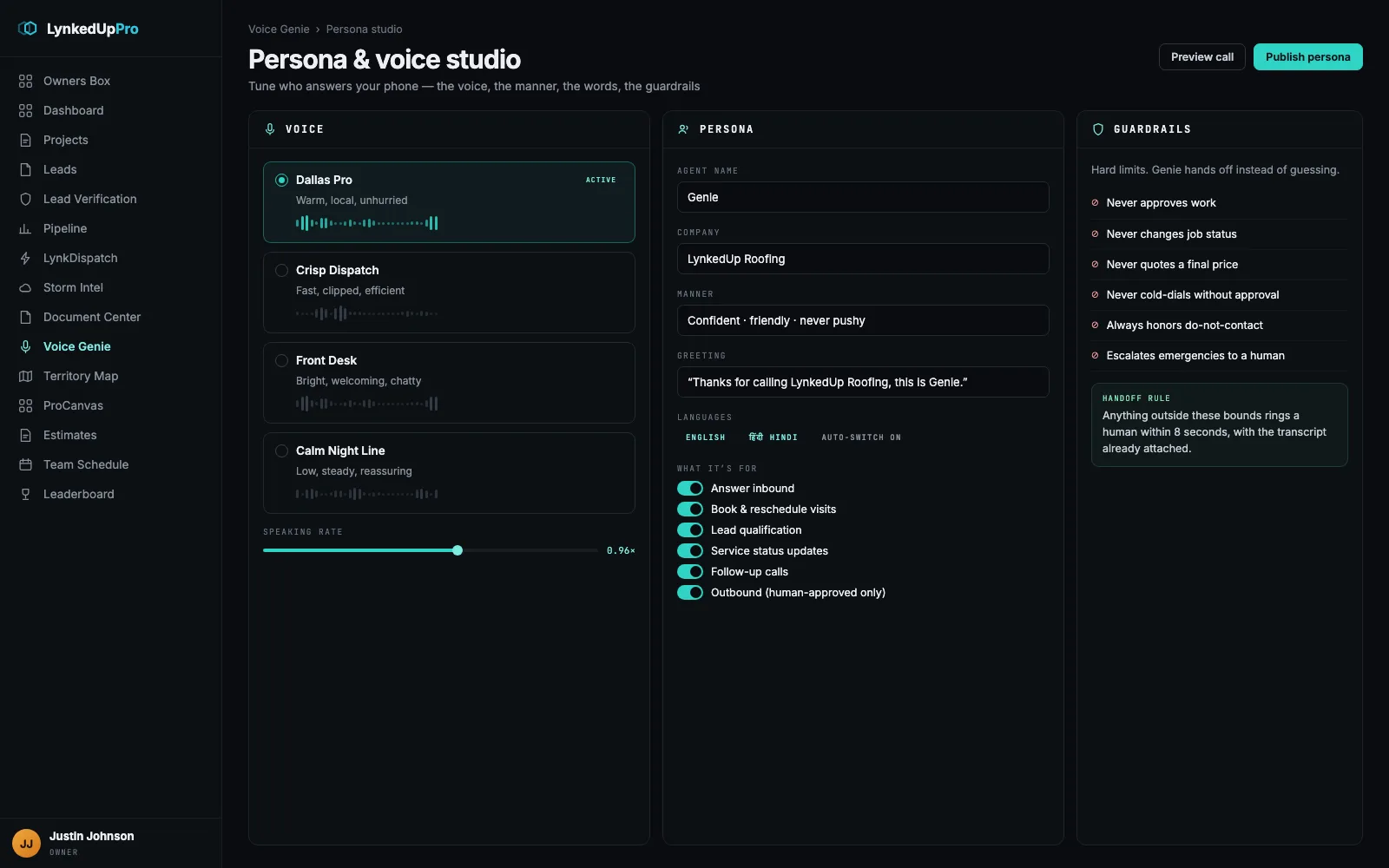
Two things make this work. First, a written emergency rule (active leak into the living space, an open roof after a storm, anything involving safety) and a weekly on-call rotation so escalations do not land on the owner every night. Keep tarping supplies ready, because a transfer only helps if someone can get out to stop the water. Second, hard limits on the AI. It should never quote a final price, approve work, or change a job's status, and it should hand off anything outside its rules.
Storm Nights Need Their Own Plan
A big hail or wind event is the hardest test of any after hours answering service for roofing. Call volume jumps far past a normal evening, and every caller is also calling your competitors. Plan before storm season starts:
- Decide how far out inspections can be booked and what callers hear when the schedule is full.
- Assign reps to territories so bookings go to the nearest available person.
- Make sure every caller who does not book gets an automatic confirmation or follow-up. A missed-call text back catches anyone who still slips through.
- On Monday, work the queue in order of urgency rather than in the order calls arrived.
Test It Yourself Before You Sign
Any virtual receptionist for roofers sounds good in a demo. Run these tests on the real thing.
- Count what you are missing now. Pull your phone logs for a normal month and a storm month. Count unanswered calls, voicemails, and after-hours calls.
- Call as a homeowner with a leak at 9 p.m. on a Saturday. Does it pick up quickly? Does it recognize the emergency and get a person on the line?
- Call as a storm lead with an open insurance claim. Does it ask about the carrier and claim status? Do you hang up with a booked time?
- Call as an existing customer. Are you routed to the person who owns your job, or treated as a new lead?
- Ask for a price. It should decline politely and offer the inspection.
- Ask if it is a person. It should answer honestly.
- Check the record. Is the lead in your CRM with the details and transcript, and did a follow-up start?
- Make three calls at once. Do all three get answered?
What to Measure After You Switch
Track a few numbers for a month before and after you change your coverage: calls outside business hours, calls that reached voicemail or went unanswered, after-hours callers who booked an inspection, and how many of those inspections became signed jobs. If calls are answered but not booked, the problem is usually the qualifying questions or calendar availability, not the answering.
Where LynkedUp Pro Fits In
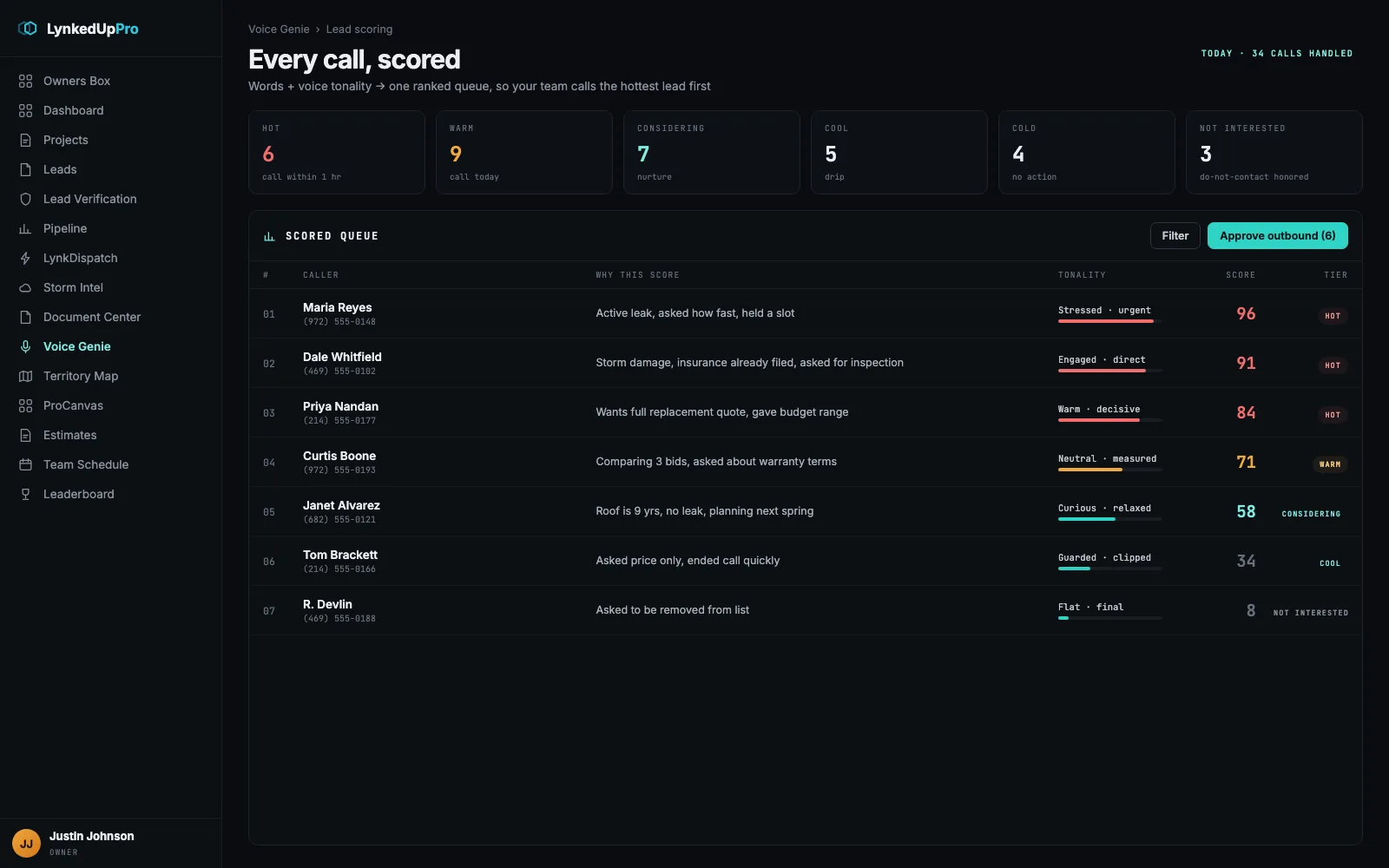
Voice Genie is the AI receptionist for contractors built into LynkedUp Pro. It answers 24/7, including weekends and holidays, qualifies callers with roofing questions (address, damage type, roof age, insurance status, urgency), books inspections against live rep and crew availability by territory, transfers emergencies live, and writes every call into the pipeline with a transcript and lead score. The Voice Genie product tour walks through each screen above.
Because the call lands in the same roofing CRM as your canvassing, web, and referral leads, nobody re-types a message, and the follow-up sequence starts on its own. If you want to hear it handle your own call types, the AI receptionist page is the place to start.
Frequently Asked Questions
What is an answering service for roofers?
It is any way of answering a roofing company's phone when the team cannot: a live remote receptionist, a traditional answering service, or an AI receptionist. The best ones qualify the caller with roofing questions and book an inspection rather than just taking a message.
Is an AI receptionist better than a human answering service?
For new leads, after hours, and storm surges, an AI receptionist usually does more: it answers calls in parallel, books on your live calendar, and logs the lead in your CRM. For existing customers and sensitive conversations, a person is better. Many roofers use both.
What happens to emergency calls after hours?
A good setup recognizes emergencies like an active leak, captures the address and callback number, and transfers the caller to your on-call person immediately with the details attached.
How much does an answering service for roofers cost?
Pricing models differ: live receptionists are usually billed monthly or hourly, answering services per minute or per call, and AI receptionists usually by subscription. Compare the cost per booked inspection rather than the headline rate.
Can a virtual receptionist handle storm-day call volume?
A human service is limited by the staff on shift and can queue callers. An AI receptionist answers calls in parallel, which is why it suits the hours after a hailstorm.