
Most roofing margin is not lost on the roof. It is lost in the gap between the measurement and the supply order: a takeoff done from memory, accessories nobody counted, a delivery that lands two days early on a driveway with no room, or a pallet of leftover shingles that never gets returned. Each one is small. Together they decide whether the job made money.
This guide walks through how to order roofing materials the way a disciplined production team does it: from the measurement to a line-item takeoff, from the takeoff to a supplier order, from the order to a delivery timed against the crew schedule, and finally into job costing so you know what the job actually used.
The Ordering Workflow, Start to Finish
- Measure. Get roof area, pitch, and linear footage for eaves, rakes, ridges, hips, and valleys. Our guide to roof measurement software covers the options.
- Estimate. Price the scope from those measurements. The estimate is your first draft of the material list, so build it from the same numbers. See how to estimate a roofing job.
- Takeoff. When the job is signed, turn the estimate into an exact order: every component, quantity, color, and accessory.
- Confirm with the homeowner. Lock the shingle line and color in writing before anything is ordered.
- Order. Send one complete order to the supplier with the delivery address, date window, and placement instructions.
- Deliver. Time the drop to the production schedule, not to when the supplier has a truck free.
- Reconcile. After tear-off and install, record what was used, what was returned, and what it cost.
The steps that go wrong are almost always 3, 6, and 7. They are also the ones that happen in different tools in most companies, which is why the numbers drift.
From Measurement to Order: The Takeoff Table
Every line on the order should trace back to a measurement. Here is how each component is usually derived. Coverage per bundle, roll, or piece varies by manufacturer and product, so always use the figure on the product label or spec sheet rather than a number someone remembers.
| Component | Comes from | How to calculate the order | Common mistake |
|---|---|---|---|
| Field shingles | Roof area (squares) and waste factor | Squares × (1 + waste %), rounded up, then bundles per square from the label | Using one waste % for every roof regardless of hips, valleys and dormers |
| Starter strip | Eaves + rakes (LF) | Linear feet ÷ coverage per bundle | Forgetting rakes when the manufacturer specifies starter there |
| Hip and ridge cap | Hips + ridges (LF) | Linear feet ÷ coverage per bundle | Counting ridges but not hips |
| Underlayment | Roof area | Area ÷ coverage per roll, allowing for laps | Ignoring lap requirements on the label |
| Ice and water shield | Eaves, valleys, penetrations (LF) | Per local code and manufacturer requirements | Ordering for valleys only when code requires eave coverage too |
| Drip edge | Eaves + rakes (LF) | Linear feet ÷ piece length, plus spares for laps and corners | No spares, so the crew stops for a supply run |
| Vents and flashing | Site inspection, not aerial data | Counted on the inspection: pipe boots, vents, step and counter flashing | Assuming existing flashing will be reused |
| Decking | Inspection allowance | Priced as an allowance per sheet in the contract, ordered on discovery | Ordering decking up front and returning most of it |
| Nails and sealant | Squares | Per manufacturer fastening pattern | Running out because the fastening pattern for high-wind zones is denser |
A Worked Example
The numbers below are an example to show the method, not typical values. Say the measurement for a gable-and-hip home comes back as:
- Roof area: 2,840 sq ft, which is 28.4 squares
- Eaves: 160 LF · Rakes: 120 LF
- Ridges and hips: 70 LF · Valleys: 40 LF
- From the inspection: 4 pipe boots, 2 exhaust vents, 1 chimney needing new step and counter flashing
The takeoff then works like this:
- Field shingles. With a 12% waste factor chosen for this roof's hips and valleys, 28.4 × 1.12 = 31.8, so you order 32 squares. If the line comes three bundles to the square (check the label), that is 96 bundles.
- Starter. Eaves plus rakes is 280 LF. Divide by the starter product's coverage per bundle and round up.
- Hip and ridge. 70 LF divided by the cap product's coverage per bundle, rounded up.
- Drip edge. 280 LF in 10 ft pieces is 28 pieces. Add 2 spares for laps and corners: 30 pieces.
- Ice and water shield. 40 LF of valleys, plus eaves if your local code requires it. Convert to rolls using the product's roll length.
- Accessories. 4 pipe boots, 2 vents, and a chimney flashing kit, straight from the inspection photos.
The point is not the arithmetic. It is that every number has a source, so when the crew lead asks why 30 drip edge pieces arrived, anyone can see where it came from.
Getting Waste Right
Waste is where most over-ordering and under-ordering starts. A plain gable roof cuts cleanly; a roof with hips, valleys, and dormers produces offcuts that cannot be reused. Rather than one company-wide number, set waste by roof complexity and adjust it when your reconciliation shows a pattern. LynkedUp Pro's estimating applies a waste factor by pitch and complexity and auto-populates material quantities from the measurement, so the takeoff starts from the measured roof instead of a blank sheet.
Placing the Supplier Order
A good supplier order removes every question the yard or the driver might have to call you about.
- One complete order per job. Split orders create split deliveries and missing items.
- Exact product names and colors, copied from the signed contract, not retyped.
- Delivery window, tied to the production date.
- Placement instructions: roof-load or ground-drop, where on the property, and anything to avoid such as sprinkler heads, septic covers, or a soft lawn.
- Site contact and the homeowner's confirmation that the driveway will be clear.
- Job reference on the order so the invoice can be matched to the job later.
When material orders are tied to the measured scope on the job record, as they are in LynkedUp Pro's roofing CRM, the order and the estimate cannot quietly disagree. The classic failure, where the estimate says 32 squares and the crew ordered 28, shows up before the truck leaves the yard rather than at invoicing.
Timing Delivery Against the Production Schedule
Material should arrive close enough to install day that it is not sitting in the weather or in the homeowner's way for a week, and early enough that a shortage can be fixed before the crew arrives. In practice that usually means delivering a day or two before the scheduled start, and confirming the day before.
The delivery belongs on the same schedule as the crew, the dumpster, and any inspection. If any of those moves, the delivery moves with it. Our guide to roofing production scheduling covers how to build that schedule.
Delivery-Day Checklist
- Count bundles, rolls, and pieces against the order before the driver leaves
- Check shingle line and color against the signed contract
- Photograph the delivered materials and the drop location
- Note any damaged or missing items on the delivery ticket
- Confirm placement did not block the driveway, garage, or neighbor access
- Cover ground-dropped materials if weather is coming
- Upload the delivery ticket to the job record
- Order shortages the same day, not the morning of install
Returns and Job Costing
The job is not finished when the last shingle goes down. Unopened bundles and unused accessories are money, but only if someone returns them and records it.
- Count leftovers at cleanup and photograph them.
- Return unopened material promptly, within the supplier's return policy.
- Match the supplier invoice and return credit to the job.
- Compare estimated vs actual material cost for the job.
- Feed it back: if a roof type keeps over-ordering, lower its waste factor; if it keeps running short, raise it.
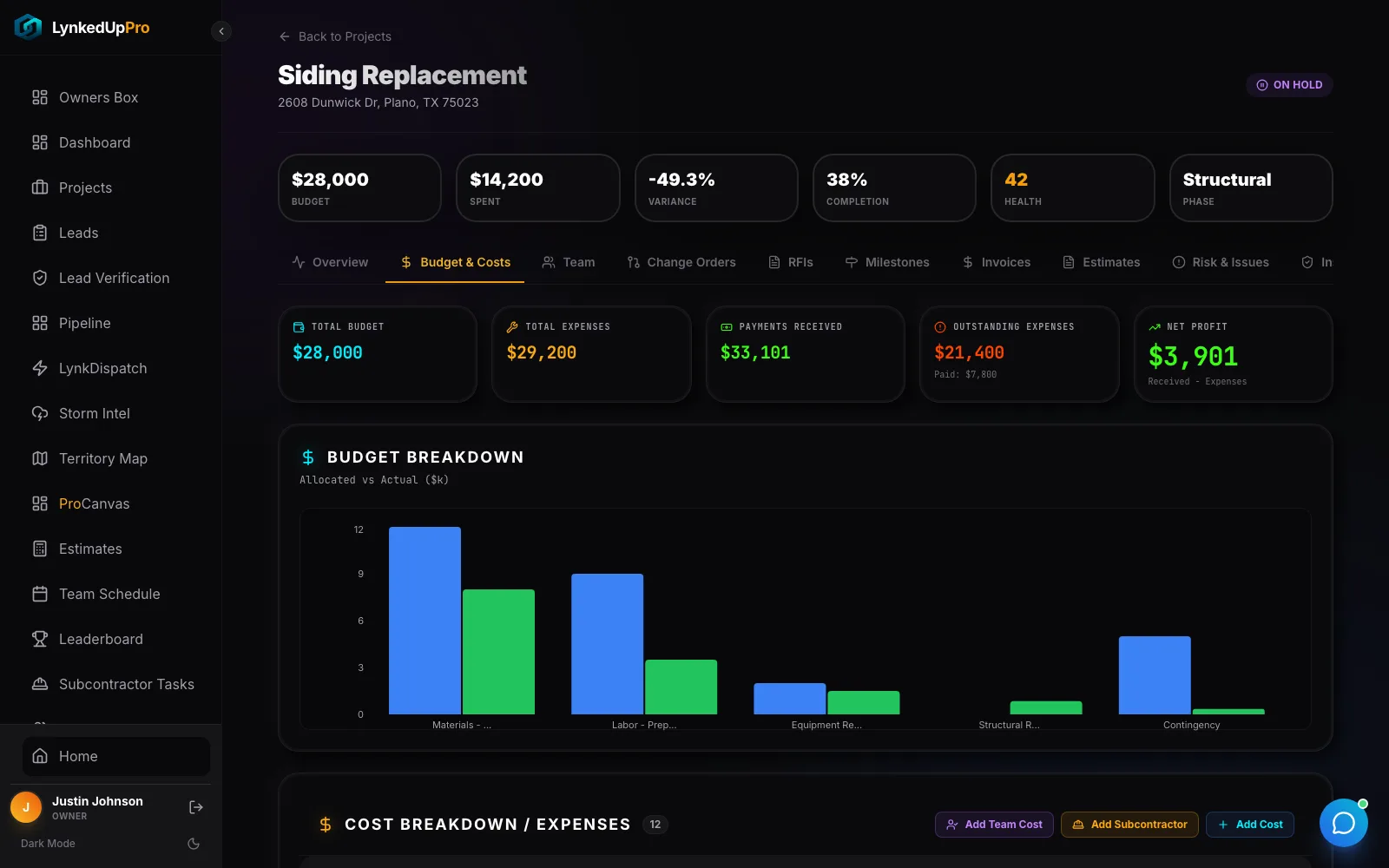
Job costing against estimated material and labour is what turns ordering from a habit into a system. Without it, you only find out a roof type is unprofitable after a season of doing them.
Frequently Asked Questions
How do roofers calculate how much material to order?
They start from the roof measurement in squares, add a waste factor based on roof complexity, convert to bundles using the product label, and calculate starter, ridge cap, drip edge, and underlayment from the measured linear footage and roof area.
What waste factor should I use for roofing?
It depends on the roof. Simple gable roofs need less, while roofs with hips, valleys, and dormers need more. Set waste by roof complexity and adjust it based on what your own completed jobs actually used.
When should roofing materials be delivered?
Usually a day or two before the scheduled install, confirmed the day before, so shortages can be fixed without leaving materials exposed for long.
Should decking be ordered up front?
Most contractors price decking as a per-sheet allowance in the contract and order it once damaged boards are found during tear-off, rather than ordering and returning it.
How does a roofing CRM help with material ordering?
It keeps the measurement, estimate, material order, delivery date, and job costs on the same record, so quantities are not retyped and differences between estimated and actual material show up immediately.